

The Utah Potash Story
At Utah Potash, we believe the land provides critically needed mineral resources — but with those resources comes serious responsibilities.
And that’s why we are a different kind of company. We have purpose and our eyes are on the future. This is our Vision:
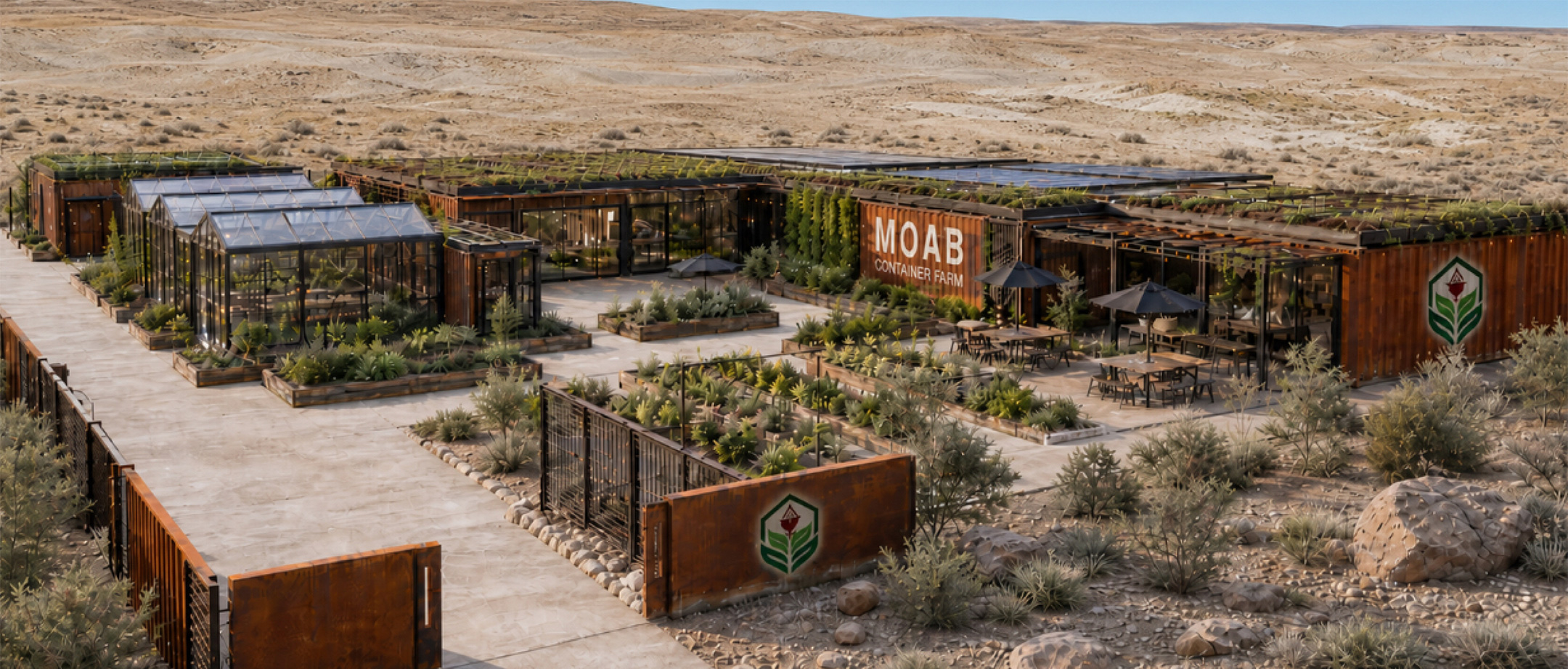
- Sustainable Growing Center
- Enclosed Potash Processing Plant
- Utah Potash Learning Environment
Our Values Speak For Themselves




Integrated & Innovative
We are recovering a critical nutrient needed by American farmers to grow the food on our table. Today 95% of this product comes from Canada, China or India—making growing food more expensive for farmers and our food system vulnerable.

No Evaporation Ponds. Ever.
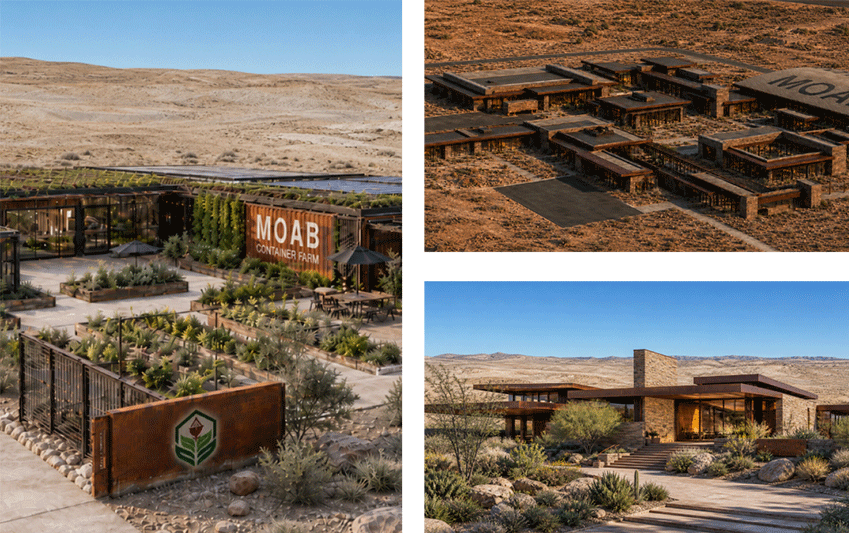
State-of-the-art, totally enclosed processing facilities are designed and landscaped to beautifully fit into their majestic high-desert surroundings. Closed water system to prevent water loss due to evaporation.

High-Desert Growing & Learning Center
Integrating a High Desert Growing Learning Center to help support sustainable agriculture efforts right here in Moab.

Geological Discoveries Museum
Honoring the legacy of Bob Norman in a Geological Discoveries Museum designed to engage visitors in the amazing minerals of Utah.
The Need
Our goal is to produce KCL responsibly and supply it economically to US growers. Our small footprint also incorporates a high-desert sustainable growing system and learning center.
6.4M
Metric Tonnes
U.S. potash demand, 2024
420K
Metric Tonnes
U.S. domestic production — just 6.6% of demand
~6.0M
Metric Tonne Gap
Structural shortfall with no domestic answer
Why use next generation technology?
Because we are the next generation and our legacy matters.

This is a family business grounded in the Bob Norman legacy.
Bob was a renowned Moab geologist and entrepreneur who mapped the region’s mineral formations and became a respected local leader. Following his passing in 2012, his daughter, Kim Norman, pledged to continue his legacy of producing potash for American farmers. Driven by her background as an avid gardener, Kim understood the vital role potassium plays in food security and was determined to reduce America’s heavy reliance on imported potash, which drives up grocery costs for everyday families.
Bringing her unique experience as a professional volleyball coach, teacher, and author, Kim knew how to turn challenges into winning streaks. True to her strengths, she began building a world-class enterprise by assembling a team of top-tier experts to plan and design every facet of Utah Potash’s operations.
Key to this leadership team is Eric Norman, Principal Consultant for Architecture, Engineering & Field Ops. A distinguished U.S. Air Force veteran, Eric brings deep domain knowledge from exploring potash and uranium in Moab alongside his father. His extensive background spans major architecture and mining projects—including AT&T Stadium and the Kennecott Copper Mine expansion—and his mastery of advanced engineering software ensures the precise planning required to build a winning enterprise.
The Right Team to Execute

Doug Mellars
Chief of Staff
Doug graduated from Brigham Young University in 1992 with a BS in Electrical Engineering before serving 28 years in the U.S. Air Force, retiring as a Colonel. As a communications officer across 14 global locations, he managed diverse technologies—including networks, satellites, and radios—and served as a two-time squadron commander, group commander, and Joint Forces Director.
Throughout his military career, Doug oversaw numerous multi-million-dollar projects and excelled at translating complex technical information for senior leaders to drive strategic decisions. He holds master’s degrees in CIO Studies (AFIT) and Strategic Studies (Air War College), and currently serves as the Club Director for High Country Volleyball.
The RESPEC has worked on nearly every potash and salt deposit worldwide and has 700+ employee-owners. The following employee-owners are assigned to the Utah Potash project with direct project-level access.

Susan Patton, PhD, PE, QP
Lead Project Manager
PhD & MS in Mining & Mineral Engineering (University of Alabama). Licensed PE and Qualified Person. Deep expertise in solution mining, mine closure, reclamation, and feasibility studies. RESPEC’s go-to specialist on potash solution mining — has co-presented RESPEC’s solution mining primers with Erik Hemstad.

Erik Hemstad
Project Manager
U.S. Marine Corps Infantry Officer veteran. BS & MS in Geological Engineering (Michigan Tech); MBA (Colorado Mesa University). Previously Senior Geological Engineer at Agapito Associates. Deep expertise in rock mechanics, geotechnical engineering, and solution mining. Co-leads RESPEC’s solution mining practice alongside Dr. Patton.

Alyssa Kendir, PE
Project Engineer
BS in Mining Engineering (Colorado School of Mines); MEng (University of Arizona). Prior experience at AngloGold Ashanti, Kiewit, Heidelberg Materials, and Hexagon Mining. Brings hands-on mine operations, mine planning, and project execution experience directly applicable to Utah Potash’s development program.

Stephanie Von Flue
Engineering Technician
20+ years supporting mining, civil, and geological engineering consulting. Certification in Geographic Information Science & Technology (Colorado Mesa University). Expert in GIS/CAD platforms: ArcGIS, AutoCAD, Revit, QGIS. Manages geological mapping, spatial datasets, and technical report production for the project.
Solution Recovery
Solution recovery, with no evaporation ponds to scar the landscape, pumped to state-of-the-art, totally enclosed processing facilities. Providing great careers to support more than 40 families.

Closed-Circuit Solution
Tapping into the mineral deposit 4000 feet below the surface, the salt solution is brought to the surface by a simple, but sophisticated, pumping station. The environmental footprint of this pumping station is about the size of a 4-person tent.

No Evaporation Ponds
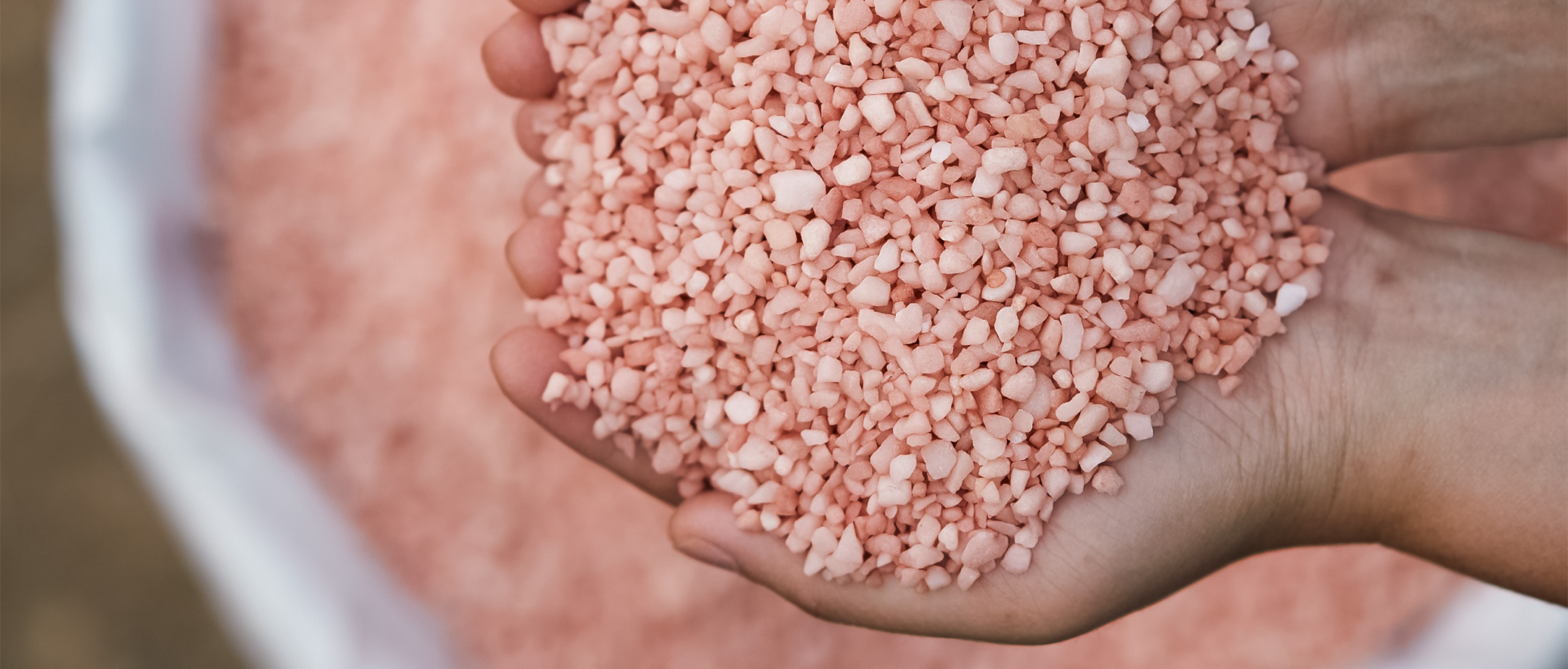
From there, the solution is pumped to a system of buildings, the size of a few large barns, where the potassium nutrient called potash is recovered to produce the recognizable pink crystals farmers put directly on the soil to fertilize their crops.

Recycled Water System
The salty brine minus the potassium is pumped back into the ground where it is part of a continual loop of harvesting potassium. This closed system eliminates the need for evaporation ponds and reduces the need for any additional water.
Right Here In Moab
We understand the importance of the beauty and majesty of our surroundings
Striving to occupy the smallest environmental footprint possible, all of Utah Potash’s impact—from the pumping station to the processing buildings and load-out—are designed to tuck in—not stand out— into the surrounding landscape. Working closely with the US Bureau of Land Management (BLM), Utah Potash is striving to position these operations in the best suitable locations to reduce land and view shed disturbance.
Transportation of the final potash product will be in trucks, or on rail, for distribution to western farmers and growers. Proximity to rail allows our production to scale up easily without impacting highway traffic, providing more potash to American farmers to help grow more high quality food.